



CrimeRadar: Dispatch Alerts
com.newsbreak.crimeradar
 Safety
Advertisement
CrimeRadar takes a niche but genuinely useful concept and packages it into a streamlined public-safety awareness tool. At its core, the app monitors live first-responder radio traffic, then uses AI to summarize incidents and place them on a map, giving users a faster way to understand what is happening nearby without having to decode raw dispatch chatter themselves. For commuters, parents, neighborhood watchers, or anyone who wants a clearer view of local incidents, that proposition is immediately compelling.
In day-to-day use, the app's biggest strength is how it reduces friction. Listening to scanner traffic directly can be noisy, fragmented, and often difficult for casual users to interpret. CrimeRadar bridges that gap by translating live dispatch activity into readable incident summaries and location-based context. That makes the experience feel far more accessible than a traditional scanner app. Instead of forcing users to sift through radio traffic line by line, it surfaces the signal from the noise, which is exactly where the AI layer earns its value.
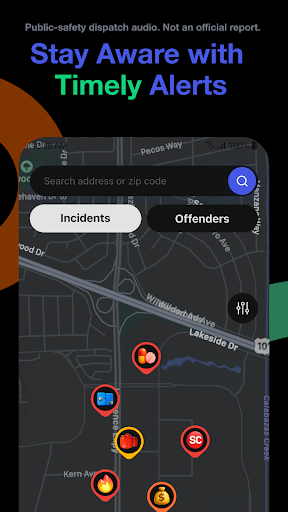
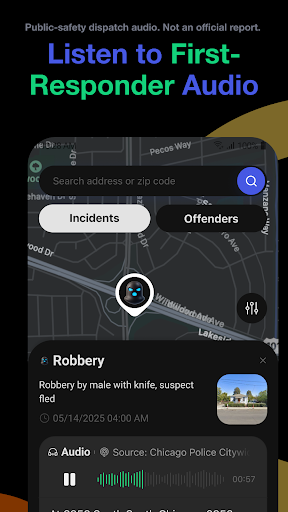
The safety map is another strong piece of the package. Being able to see recent incidents plotted geographically gives the app a practical, at-a-glance quality that many alert platforms still lack. Even better, CrimeRadar does not completely abstract away the source material. Users can tap into original first-responder communications tied to specific events, which adds a welcome layer of transparency. That balance between summarized intelligence and raw source access makes the platform feel more trustworthy and more robust than apps that rely purely on automated alerts.
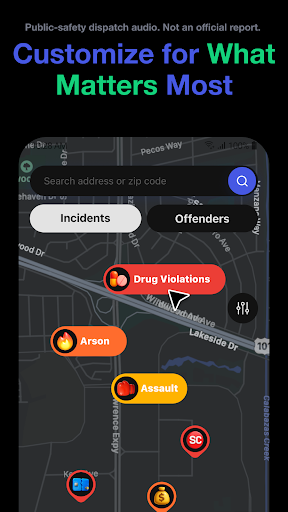
Customization also plays an important role in the user experience. The ability to filter by incident type across alerts, logs, and the map helps keep the app relevant instead of overwhelming. That said, the app's usefulness will naturally depend on local radio coverage, dispatch clarity, and how accurately the AI interprets fast-moving situations. Public-safety incidents can evolve quickly, so summaries may not always capture the full nuance in real time. Users looking for official emergency guidance should still treat this as a situational-awareness companion rather than a definitive authority.
Overall, CrimeRadar is an intuitive and thoughtfully positioned app that modernizes scanner monitoring for a broader audience. Its mix of live radio access, AI-generated summaries, mapped incidents, and configurable alerts creates a practical tool for staying informed about nearby public-safety activity. It is not a replacement for official emergency systems, but as a real-time awareness platform, it feels timely, useful, and surprisingly polished.









Comments